“Not all screen time is equal and not all alternatives to it need to be screen-free.”
Most parents already sense that something about their child’s screen habits isn’t quite right, even if they can’t always name what. The honest question isn’t whether screens are “bad” it’s whether there’s something that gives kids what a good screen activity promises, without the attention costs a bad one extracts. In this guide, we’ll look at what the research actually says about screens and attention, what chess specifically does differently, and where chess realistically fits into a family’s day.
1. The Screen-Time Reality Parents Are Actually Facing
Global data on children’s screen habits paints a fairly stark picture: kids aged 8 to 12 average roughly five and a half hours of screen time a day, and teenagers average closer to eight and a half. Most parents, when asked, say they’d consider around nine hours a week to be the ideal limit meaning actual screen time is running more than double what parents themselves consider healthy.
That gap isn’t just a statistic parents shrug off, either. More than half of parents surveyed say they suspect their child is already showing signs of screen addiction, and a similar share admit to feeling guilty about how much screen time their household allows. This isn’t a fringe worry it’s close to the median parenting experience right now.
Even public health guidance has had to adapt to this reality. In early 2026, the American Academy of Pediatrics dropped its long-standing two-hour daily screen limit for school-aged kids in favor of a framework focused on the quality of screen use rather than a hard number of minutes an implicit admission that not all screen time carries the same cost, and that a single time limit was never going to capture what actually matters.
2. What the Research Actually Shows Chess Builds
The distinction between passive and active screen time turns out to matter enormously. A 2026 systematic review found that passive screen time the scrolling, autoplay-driven kind has a consistently negative association with children’s attention, while more interactive, goal-directed screen activities can actually support cognitive development rather than erode it. Chess, notably, sits on the “active” side of that line even when it’s played on a screen.
The attention research specifically on chess is striking. In one study, children who played chess improved by 15 points on a standardized attention scale over the study period, compared to just 2 points in a control group who improved only through normal maturation a roughly 13-point gap attributable to chess itself. Brain-imaging research adds a mechanism to that finding: passive screen time has been linked to reduced neural markers of inhibitory control, while chess directly exercises that same capacity every time a player has to resist grabbing a piece impulsively and calculate instead.
This isn’t a one-study finding, either. A joint research effort involving the University of Cambridge, Virginia Commonwealth University, and the U.S. Department of Education’s Institute for Education Sciences found that children in chess programs showed measurable gains in planning, sequencing, working memory, and critical thinking consistent enough across studies and countries that chess is now formally classified as a STEM activity under U.S. education policy.
3. Not All Screens Are Equal — Where Chess Actually Fits
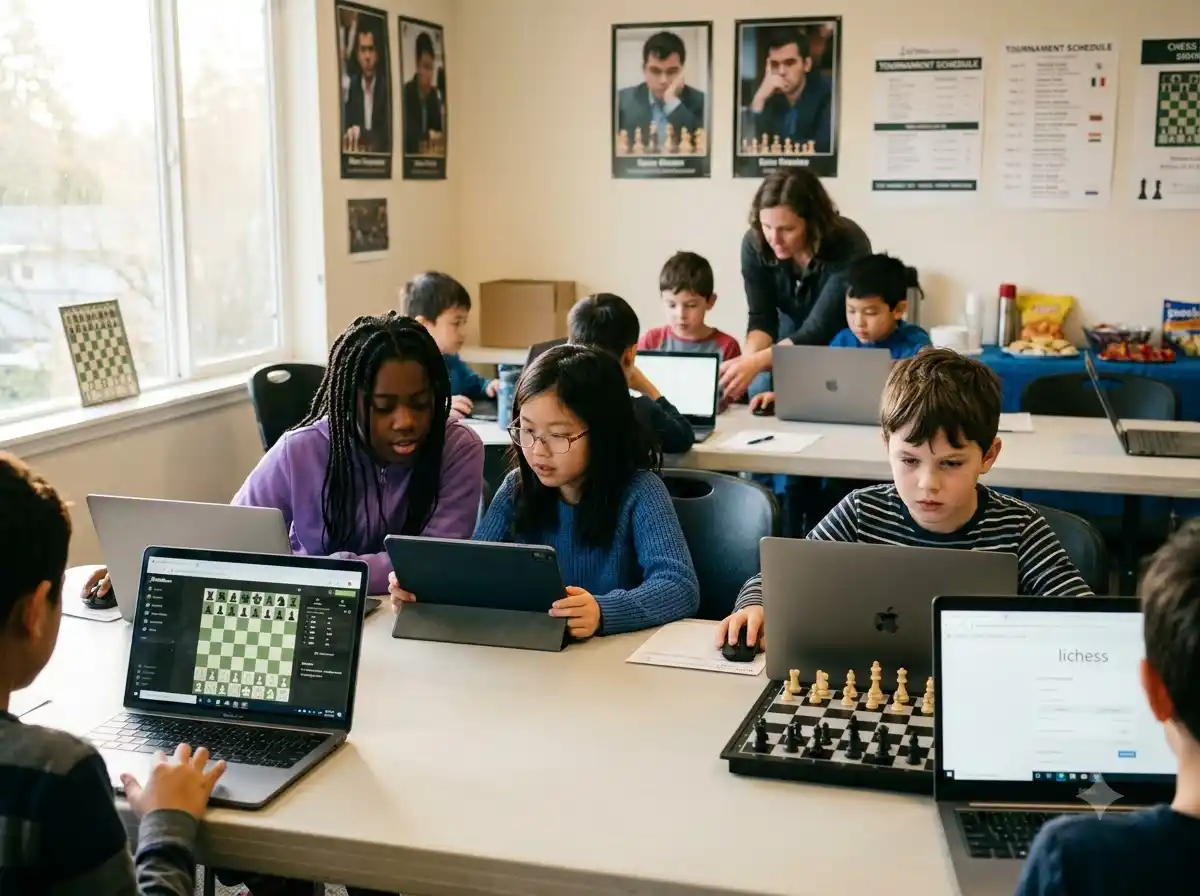
Here’s the nuance that a simple “screens bad, chess good” framing misses: chess itself is often played on a screen, whether that’s an online lesson, a puzzle app, or a game against a computer. The difference isn’t the pixels it’s what the activity demands of the brain while it’s happening. An hour of doomscrolling and an hour of solving chess puzzles both technically count as “screen time,” but one trains rapid attention-switching chasing the next quick hit, while the other demands sustained focus on a single, evolving problem.
That structural difference matters for a second reason too: chess as a platform doesn’t run on the same engagement mechanics that make so much kids’ media hard to put down. There’s no infinite scroll, no algorithm tuned to maximize time-on-app, no push notifications engineered to pull a child back in. A chess session ends because the game ends, not because a recommendation engine decided what comes next.
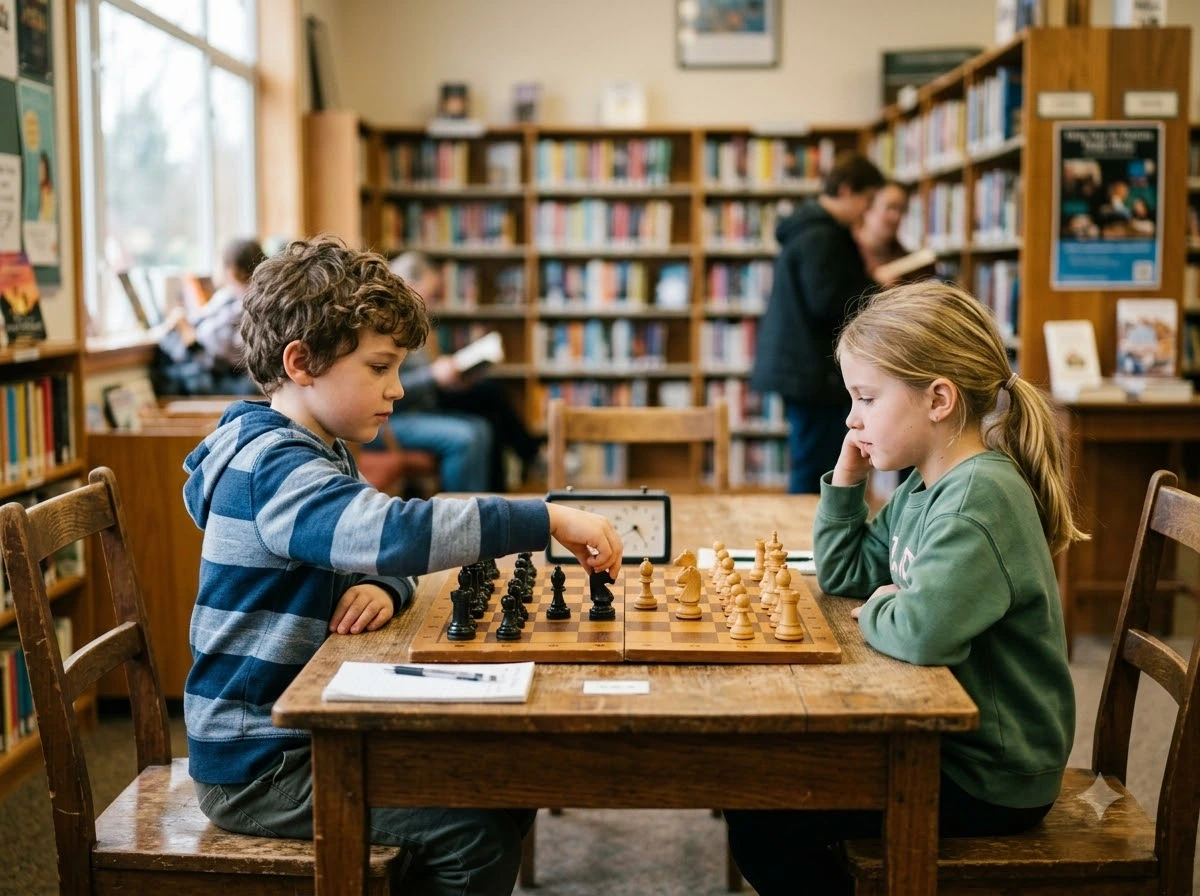
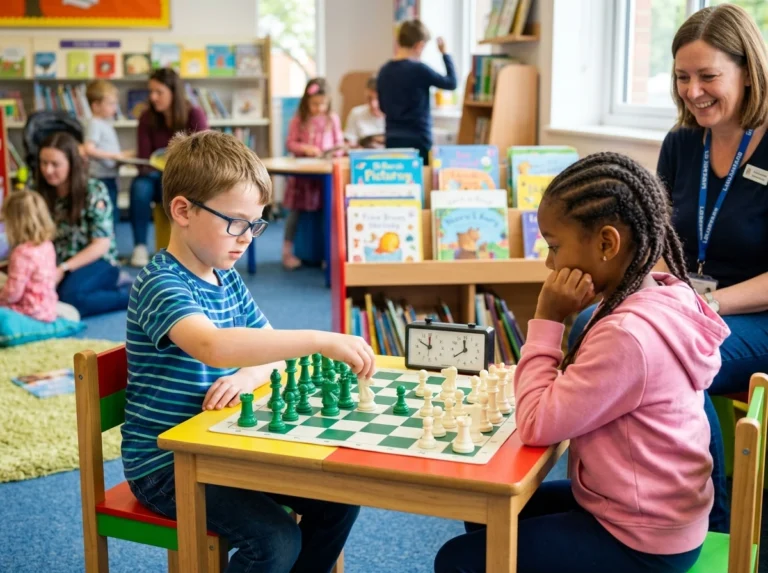
That makes chess a flexible answer rather than an all-or-nothing one. Families who want to cut screen time entirely can hand a child a physical board and a coach; families who can’t avoid screens entirely still get a meaningfully different kind of screen time when a child is doing tactics puzzles instead of watching autoplaying videos. Either way, the mental demands sustained attention, delayed gratification, real consequences for a rushed decision are the same ones passive screen use tends to erode.
3. Not All Screens Are Equal — Where Chess Actually Fits
Here’s the nuance that a simple “screens bad, chess good” framing misses: chess itself is often played on a screen, whether that’s an online lesson, a puzzle app, or a game against a computer. The difference isn’t the pixels it’s what the activity demands of the brain while it’s happening. An hour of doomscrolling and an hour of solving chess puzzles both technically count as “screen time,” but one trains rapid attention-switching chasing the next quick hit, while the other demands sustained focus on a single, evolving problem.
That structural difference matters for a second reason too: chess as a platform doesn’t run on the same engagement mechanics that make so much kids’ media hard to put down. There’s no infinite scroll, no algorithm tuned to maximize time-on-app, no push notifications engineered to pull a child back in. A chess session ends because the game ends, not because a recommendation engine decided what comes next.
That makes chess a flexible answer rather than an all-or-nothing one. Families who want to cut screen time entirely can hand a child a physical board and a coach; families who can’t avoid screens entirely still get a meaningfully different kind of screen time when a child is doing tactics puzzles instead of watching autoplaying videos. Either way, the mental demands sustained attention, delayed gratification, real consequences for a rushed decision are the same ones passive screen use tends to erode.
Free Demo Class for Kids
Conclusion
The research is fairly consistent: it’s not screen time itself that damages a child’s attention, it’s the passive, algorithm-driven kind and chess sits firmly outside that category whether it’s played on a board or a screen. Structured play builds exactly the skills passive scrolling wears down: sustained focus, impulse control, and the patience to think before acting. For a parent looking for something that actually replaces what a bad screen habit costs a child, rather than just adding another activity to the calendar, chess is one of the few options with real evidence behind it.
Curious what that structured chess time could look like for your child? Head to venturechessacademy.com to book a free trial session and see how a focused, screen-optional session compares to an hour of scrolling.
FAQ
Q: Does chess only count as a "healthy" alternative if it's played on a physical board?
A: No the research points to how the activity engages attention, not the medium. Chess puzzles or lessons on a screen still demand sustained, goal-directed focus, unlike passive scrolling or autoplay video.
Q: How much chess time would actually make a difference?
A: The studies showing attention gains involved structured, regular play over months, not occasional sessions consistency matters more than any single session length.
Q: My child resists chess as "another lesson" how do I introduce it without it feeling like schoolwork?
A: Keep early sessions short and low-pressure, and let curiosity lead rather than framing it as mandatory practice a chessboard left out and accessible often does more than a scheduled requirement.