“The right age to start chess isn’t a number on a calendar it’s a set of signs your child is already showing you.”
Parents ask this question earlier than almost any other before curriculum, before coaches, before results. It’s a fair worry: start too early and chess becomes a frustrating chore; wait too long and it can feel like a missed window. Here’s what the research actually says about age and readiness, and how to tell if your child is ready right now rather than guessing from a birthday.
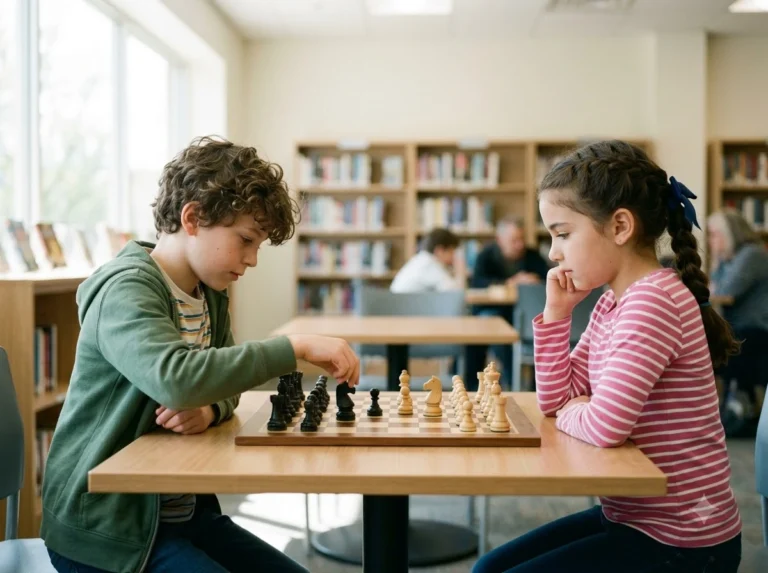
1. Why There's No Single "Right Age"
If you’re hoping for one clean number, the honest answer is that it doesn’t exist most experts converge on a range of roughly 6 to 8 for structured, formal instruction, while play-based introduction through stories and movement can start as early as 3 or 4. That range isn’t vague hedging; it reflects real variation in how children develop, not a lack of research.
Developmental psychologists explain part of this using Piaget’s framework, where children roughly ages 2 to 7 sit in what’s called the preoperational stage. Chess draws on a specific bundle of cognitive tools strategic planning, visuospatial memory, pattern recognition, the ability to resist an impulsive move, and the capacity to anticipate what an opponent will do next and these don’t all mature on the same schedule. A child can be ready for one part of the game and not another, which is exactly why age alone is such an unreliable predictor.
This is also why two children born the same year can be at completely different starting points. One six-year-old might already sit calmly through a 20-minute puzzle; another might still be building the patience for turn-based games generally, chess or otherwise. Neither is behind they’re just on different timelines for the same set of skills.
2. The Readiness Signals That Matter More Than a Birthday
Instead of counting years, most experienced coaches recommend watching for a specific set of behaviors. A basic attention span of roughly 15 to 20 minutes on a single activity is one of the clearest signals if your child can focus on a puzzle or task for that long without needing a break, they’re likely ready for structured chess sessions of similar length.
Turn-taking ability is just as important, and it doesn’t have to come from chess itself. A child who’s comfortable waiting their turn in any rule-based game a board game, a sport with rotating turns is showing the same underlying patience chess requires move after move. Comfort with rules generally, even ones that seem arbitrary to an adult, is a related signal worth watching for.
The hardest signal to spot, but arguably the most important, is frustration tolerance. Chess involves losing pieces, missing tactics, and occasionally losing entire games a child who can sit with that discomfort without giving up or melting down is showing genuine readiness, regardless of age. A child who isn’t there yet isn’t a bad fit for chess forever; they may just need a bit more time with lower-stakes games first.
3. What the Research Actually Says About Starting Early vs. Late
The data on outcomes is more reassuring than most parents expect. A 2007 Oxford study looking at young elite chess players found that starting age wasn’t what separated them from everyone else specific personality traits, particularly high openness to experience, low neuroticism, and unusual persistence, were the real differentiators. Starting early didn’t create those traits; it just gave children who already had them more time to apply them.
Separate research backs up chess’s cognitive benefits regardless of exact starting age: a study tracking children ages 5 to 16 over a year of weekly training found real gains in verbal reasoning, and more recent research on kindergarteners found improvements across attention, memory, logical thinking, patience, and even academic scores in math and reading. One caveat worth knowing: children who are already academically struggling often don’t see the same immediate benefit, and typically need more time and support before the gains show up.
Perhaps the clearest real-world evidence comes from two contrasting champions. Magnus Carlsen started at 5 but showed little real interest and didn’t get serious until 8; Mikhail Botvinnik didn’t start until 12 and still became a three-time World Champion. The common thread wasn’t their starting age at all it was that neither one was pushed into it before they were genuinely ready.
Free Demo Class for Kids
Conclusion
There’s no single correct age to start chess, and chasing one is largely a distraction from what actually matters: whether your child is showing the readiness signals sustained attention, turn-taking, and the patience to sit with a hard position rather than whether they’ve hit a specific birthday. The research is clear that starting a bit later rarely closes any real door, while pushing a child in before they’re ready is the more common source of lost enthusiasm.
Not sure where your child stands? Head to venturechessacademy.com to book a free trial session, and a coach can help you see exactly where your child’s readiness is today.
FAQ
Q: Is my child already too old to start if they're past age 8?
A: Not at all plenty of strong players, including world champions, started well past this window. Age 8 onward is simply a different (not worse) entry point into the game.
Q: My child gets frustrated easily during games should I wait?
A: Not necessarily wait entirely, but consider starting with shorter, lower-pressure sessions focused on fun rather than competition until frustration tolerance builds naturally.
Q: Does starting early guarantee my child will become a strong player?
A: No the research consistently shows personality traits like persistence matter more than starting age. An early start without genuine interest often backfires into burnout rather than mastery.