Introduction to Anastasia's Mate
There are chess defeats that teach slowly a gradual positional squeeze, a long endgame conversion, a strategic error that compounds over thirty moves. And then there are the other kind: sudden, brutal, and final. A queen lands somewhere unexpected, a rook slides to the back rank, and the game is over before you have fully processed what just happened. Anastasia’s Mate belongs to that second category, and it is one of the most instructive examples of how a position that looks completely safe can transform into a forced checkmate in the space of two or three moves.
In online chess, where time pressure is almost always a factor and the clock discourages deep calculation, Anastasia’s Mate claims victims at every rating level with consistent regularity. In tournament chess, where the stakes are higher and the positions more deeply prepared, it appears in subtler, more disguised forms but it appears nonetheless. At Venture Chess Academy, we have observed that players who study this pattern from the defensive perspective consistently demonstrate greater king safety awareness, superior middlegame judgment, and more reliable results under pressure than those who know the pattern only as an attacking weapon.
This blog is a complete defensive guide to Anastasia’s Mate. By the time you finish reading, you will understand not just what the pattern is, but when it arises, why it is so frequently missed, and precisely what you need to do in online blitz, in rapid games, and in classical tournament chess to ensure it never ends one of your games.
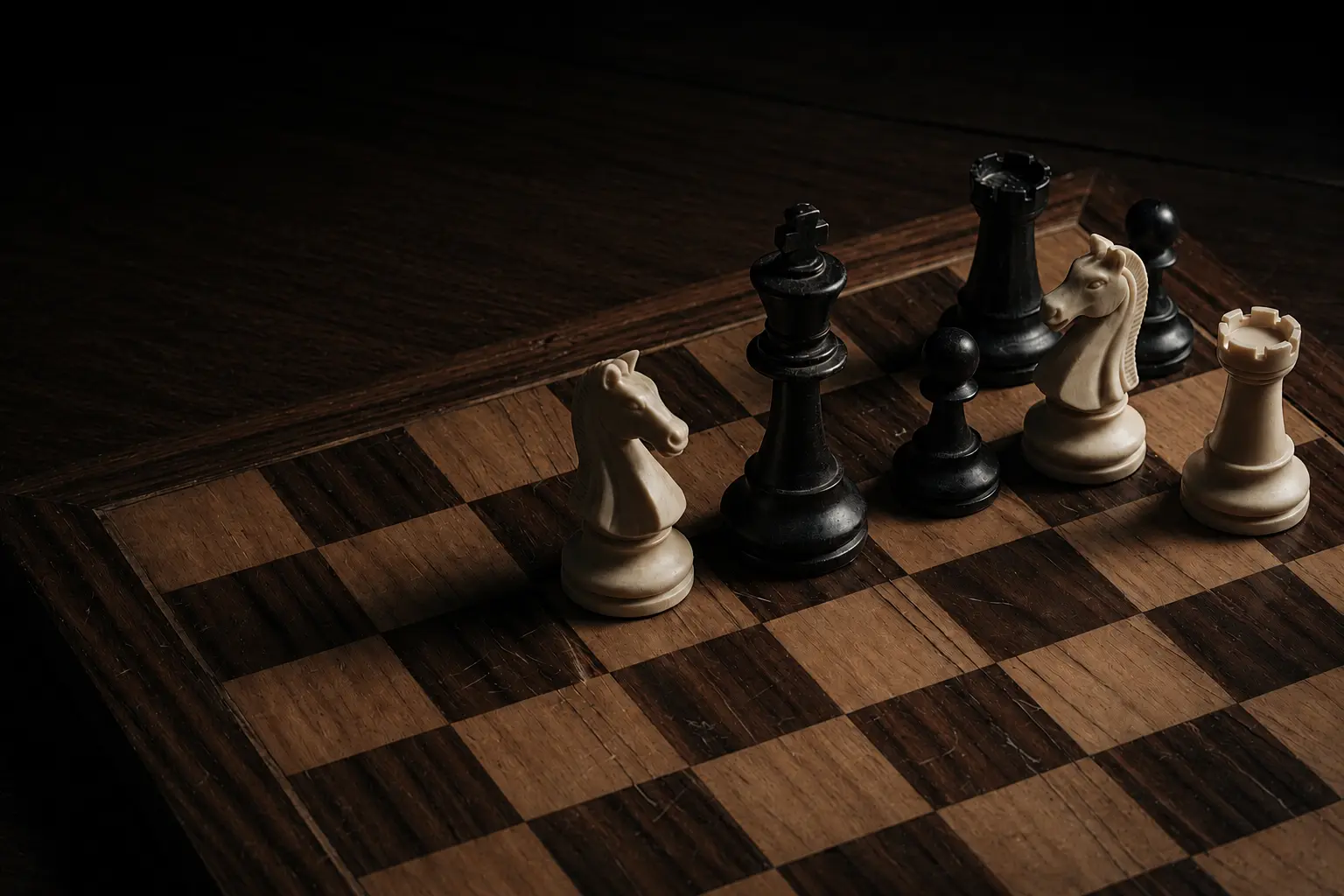
How Anastasia's Mate Works
Understanding the mechanics of Anastasia’s Mate with precision is the essential first step in learning to avoid it. The pattern involves a knight and a rook (or queen) coordinating to checkmate an enemy king that is trapped on the edge of the board by its own pawns.
In its most common form, the scenario unfolds on the kingside after castling. The defending king sits on g8 with pawns on g7 and h7 still in place a structure that looks secure but is, under the right attacking conditions, an inescapable cage. The attacking knight is posted on e7, from which it controls g6, g8, c8, c6, d5, and f5. Crucially, it covers g6 the one escape square the king might otherwise use. With the h-file open, the attacker’s rook slides to h8, and the king has nowhere to go. The pawns on g7 and h7 block every escape. Checkmate.
The pattern can also arise with a queen on h8 instead of a rook, with the knight on f6 instead of e7 in certain positional configurations, and on the queenside with the king on a8 or b8 and the knight on c7. All variations share the same structural DNA: a knight controlling the critical flight square, a linear piece on the back rank, and the king imprisoned by its own defensive formation. The inversion at the heart of this pattern the king’s own pawns becoming the bars of its cell is what makes it both aesthetically striking and defensively treacherous.
Common Scenarios Where Anastasia's Mate Occurs
Anastasia’s Mate does not appear randomly. It arises from specific positional and structural conditions that repeat across countless games. Recognizing these scenarios is the first line of defense.
The most fertile ground for this mating pattern is the classical kingside castling structure where the h-file has been forced open. This occurs most frequently after a pawn exchange on h6 or h5, a piece sacrifice to remove the h7-pawn, or a pawn storm where the attacker advances h4–h5 and creates an open file through piece play. The moment the h-file opens and the defending player has not placed a rook there to contest it, the conditions for Anastasia’s Mate begin to take shape.
The second common scenario is the exchange sacrifice on g7. In many attacking lines, the opponent sacrifices a rook or bishop on g7 to eliminate the defender’s kingside bishop, open lines toward the king, and simultaneously weaken the pawn structure that will eventually serve as the king’s prison. Players who accept these sacrifices without fully calculating the consequences frequently find themselves facing Anastasia’s Mate within five to seven moves.
The third scenario involves the queenside mirror on the a-file, which is far less frequently recognized than the kingside version. When a player has castled queenside with pawns on a7 and b7 and the a-file opens, the exact same mating geometry becomes available with the knight on c7 and the rook on a8. Because so many players study Anastasia’s Mate exclusively in its kingside form, the queenside version catches them completely unprepared.
In online chess specifically, rapid and bullet time controls create a fourth scenario: the blunder under time pressure. A position that a player would correctly evaluate and defend in a slow game is mishandled in thirty-second increments. The knight reaches e7 while the clock is ticking, the h-file opens in the scramble, and Anastasia’s Mate arrives before the defending player has had a moment to recalculate. Understanding the pattern deeply enough that it triggers an automatic defensive response even under extreme time pressure is one of the most practically valuable skills this guide will help you build.
Key Warning Signs and Early Detection
The ability to detect Anastasia’s Mate before it becomes unstoppable is a skill rooted in pattern recognition. These are the warning signs that must become automatic triggers in your defensive evaluation.
The first and most reliable warning sign is your opponent’s knight approaching e7 along any of its natural routes from c6, d5, f5, or g6. Each of these intermediate squares is a staging post on the journey to the critical outpost. The moment you see your opponent’s knight on one of these squares with a clear path to e7, evaluate whether the h-file is open or about to be opened. If both conditions are approaching simultaneously, you are in immediate danger.
The second warning sign is an opponent’s rook or queen relocating to the h-file without an obvious immediate purpose. Experienced attacking players often position their rook on h1 or h4 several moves before the mating combination is ready, precisely because it looks like normal piece activity rather than a concrete threat. If your opponent’s rook has moved to the h-file and you cannot identify a clear immediate reason for it, assume the worst and evaluate accordingly.
The third warning sign is any sacrifice material or positional directed at the h-file or the g7-pawn. When your opponent offers material to open the h-file or remove a pawn that was shielding your king, that sacrifice must be evaluated not in terms of what material you gain, but in terms of what mating threats it enables. The material offered is almost always irrelevant if Anastasia’s Mate follows within two or three moves.
The fourth warning sign is the absence of defensive coverage on h8. In any position where your king is castled kingside, h8 must be covered by one of your pieces your rook, your queen, or at minimum a piece that can rapidly return to the back rank. Conducting a quick mental check of h8 coverage every five to seven moves is a simple, high-value defensive habit that prevents a wide range of back-rank disasters, Anastasia’s Mate prominent among them.
Free Demo Class for Kids
Key Warning Signs and Early Detection
The ability to detect Anastasia’s Mate before it becomes unstoppable is a skill rooted in pattern recognition. These are the warning signs that must become automatic triggers in your defensive evaluation.
The first and most reliable warning sign is your opponent’s knight approaching e7 along any of its natural routes from c6, d5, f5, or g6. Each of these intermediate squares is a staging post on the journey to the critical outpost. The moment you see your opponent’s knight on one of these squares with a clear path to e7, evaluate whether the h-file is open or about to be opened. If both conditions are approaching simultaneously, you are in immediate danger.
The second warning sign is an opponent’s rook or queen relocating to the h-file without an obvious immediate purpose. Experienced attacking players often position their rook on h1 or h4 several moves before the mating combination is ready, precisely because it looks like normal piece activity rather than a concrete threat. If your opponent’s rook has moved to the h-file and you cannot identify a clear immediate reason for it, assume the worst and evaluate accordingly.
The third warning sign is any sacrifice material or positional directed at the h-file or the g7-pawn. When your opponent offers material to open the h-file or remove a pawn that was shielding your king, that sacrifice must be evaluated not in terms of what material you gain, but in terms of what mating threats it enables. The material offered is almost always irrelevant if Anastasia’s Mate follows within two or three moves.
The fourth warning sign is the absence of defensive coverage on h8. In any position where your king is castled kingside, h8 must be covered by one of your pieces your rook, your queen, or at minimum a piece that can rapidly return to the back rank. Conducting a quick mental check of h8 coverage every five to seven moves is a simple, high-value defensive habit that prevents a wide range of back-rank disasters, Anastasia’s Mate prominent among them.
Key Warning Signs and Early Detection
The ability to detect Anastasia’s Mate before it becomes unstoppable is a skill rooted in pattern recognition. These are the warning signs that must become automatic triggers in your defensive evaluation.
The first and most reliable warning sign is your opponent’s knight approaching e7 along any of its natural routes from c6, d5, f5, or g6. Each of these intermediate squares is a staging post on the journey to the critical outpost. The moment you see your opponent’s knight on one of these squares with a clear path to e7, evaluate whether the h-file is open or about to be opened. If both conditions are approaching simultaneously, you are in immediate danger.
The second warning sign is an opponent’s rook or queen relocating to the h-file without an obvious immediate purpose. Experienced attacking players often position their rook on h1 or h4 several moves before the mating combination is ready, precisely because it looks like normal piece activity rather than a concrete threat. If your opponent’s rook has moved to the h-file and you cannot identify a clear immediate reason for it, assume the worst and evaluate accordingly.
The third warning sign is any sacrifice material or positional directed at the h-file or the g7-pawn. When your opponent offers material to open the h-file or remove a pawn that was shielding your king, that sacrifice must be evaluated not in terms of what material you gain, but in terms of what mating threats it enables. The material offered is almost always irrelevant if Anastasia’s Mate follows within two or three moves.
The fourth warning sign is the absence of defensive coverage on h8. In any position where your king is castled kingside, h8 must be covered by one of your pieces your rook, your queen, or at minimum a piece that can rapidly return to the back rank. Conducting a quick mental check of h8 coverage every five to seven moves is a simple, high-value defensive habit that prevents a wide range of back-rank disasters, Anastasia’s Mate prominent among them.
How to Prevent Anastasia's Mate: Core Strategies
Prevention is always more efficient than emergency defense. These core strategic principles, applied consistently throughout the game, create positions where Anastasia’s Mate is structurally impossible.
The first and most important preventive measure is maintaining active coverage of the g6 square. The knight on e7 controls g6 this is the geometric key to the entire pattern. If you ensure that g6 is covered by your own knight, bishop, or pawn at all times, the attacking knight on e7 cannot seal the mating net. A bishop on h7, a knight on f8, or a pawn advance to g6 (in the right structural context) all serve this purpose.
The second preventive strategy is contesting the h-file the moment it opens. The instant your opponent achieves an open h-file, place your own rook on h8 to contest it. A pair of rooks traded on the h-file typically defuses the most immediate danger, and if your opponent declines the exchange, their rook remains under pressure rather than freely delivering threats. Do not allow the h-file to become a one-sided highway contest it immediately and actively.
The third strategy is creating a king escape square with a timely h6 advance. When played proactively before the attack has arrived h7–h6 costs almost nothing and destroys the closed pawn structure that Anastasia’s Mate depends upon. The king gains a flight square on h7, and the mating geometry collapses. The weakness created on h6 is real but manageable; the alternative is a potentially forced checkmate. Make this move before you need it, not after.
The fourth preventive strategy is eliminating the attacking knight before it reaches e7. When you see your opponent’s knight heading toward its ideal outpost, trade it off immediately using your own knight, bishop, or even a pawn advance to challenge or eliminate it. A knight that never reaches e7 cannot participate in Anastasia’s Mate. This exchange may appear to concede a positional asset, but preventing the mating combination is an overwhelming compensation.
The fifth strategy and the one that distinguishes experienced defenders from reactive ones is counter-attacking rather than purely defending. When you identify that your opponent is building toward Anastasia’s Mate, the most dynamic response is to generate concrete threats against their own king. If your counter-attack is sufficiently dangerous, your opponent must abandon or delay the mating construction to address it. Passive defense invites the attacker to complete their plan at leisure; active counter-play forces them to make uncomfortable choices.
7 Common Mistakes That Lead to Anastasia's Mate
These are the errors that create the conditions for this mating pattern, observed consistently across players of all levels in both online and tournament settings.
Mistake 1 — Weakening the kingside pawn structure unnecessarily. Moving the g- or h-pawn without a specific, calculated reason creates the structural conditions for Anastasia’s Mate. Every pawn advance in front of a castled king must be justified by a concrete positional or tactical benefit that outweighs the kingside weakening it creates.
Mistake 2 — Ignoring the knight’s approach to e7. Players focus on immediate threats — checks, piece captures, obvious tactical shots — and fail to track the slower, more strategic maneuver of the opponent’s knight toward its ideal outpost. Developing the habit of asking “where is my opponent’s knight heading?” every few moves is a simple corrective.
Mistake 3 — Abandoning the h-file. Failing to contest an open h-file immediately allows your opponent to establish dominance there without resistance. The h-file, once conceded, becomes the avenue along which the decisive rook travels. Contest it early, contest it actively, and do not allow it to become a one-sided attacking lane.
Mistake 4 — Poor piece coordination in defense. Anastasia’s Mate becomes possible when no defending piece covers g6, h7, and h8 simultaneously. Scattered, uncoordinated pieces leave these critical squares unguarded and create the vacuum the attacker exploits. Maintaining a mental picture of which piece covers each critical defensive square is a fundamental habit of strong defensive play.
Mistake 5 — Missing tactical warnings in the middlegame. Overlooking the combination of signals — knight approaching e7, h-file open or opening, opponent’s rook on the h-file — that collectively announce the pattern is approaching. No single signal demands immediate action; all of them together demand it urgently. Train yourself to read the position holistically, not signal by signal.
Mistake 6 — Passive defense once the pattern emerges. Responding to Anastasia’s Mate with reactive, one-move-at-a-time defensive measures allows the attacker to dismantle each response systematically. Once the pattern is recognized, the defensive response must be active — counter-attacking, eliminating the knight, or fundamentally disrupting the attacking coordination rather than simply blocking individual threats.
Mistake 7 — Underestimating queen sacrifices and decoy moves. Accepting a queen sacrifice near the kingside without fully calculating the resulting position is one of the most common causes of sudden defeat in this pattern. The queen is sacrificed to deflect the defender of h8 or to force the king into the exact square where the mating net closes. Never accept a sacrifice near your castled king without calculating at least three to four moves deep.
Defensive Techniques and Counterplay
When Anastasia’s Mate is already taking shape and purely preventive measures are no longer available, these defensive techniques offer the best practical chances.
The back-rank rook contest remains available in many positions even after the h-file has been opened. Placing your rook on h8 forces your opponent to either exchange rooks defusing the most immediate threat or maintain their rook under pressure rather than freely threatening mate. If the exchange occurs, recalculate whether the knight on e7 alone can construct a mating net with the queen; in many cases, it cannot without the rook’s support on the file.
The king escape maneuver Kg8–f8–e7 is a more dramatic defensive resource that occasionally saves positions that appear completely lost. By walking the king toward the center rather than remaining on the back rank, the defender removes it from the zone where Anastasia’s Mate is geometrically possible. This maneuver requires that the path be clear of checks and that the king can reach e7 or d6 before the mating net closes but in positions where no other defense exists, a king march toward the center is a legitimate and often effective last resort.
The piece deflection counter-sacrifice is available in positions where a single opponent’s piece often the knight on e7 or the rook on h7 is the keystone of the mating construction. Sacrificing material to deflect or eliminate that piece disrupts the entire combination and may convert a lost position into a playable endgame. Calculate these deflection sacrifices precisely: the material cost must be weighed against the mating threat it neutralizes and the resulting position’s long-term viability.
Active queenside counter-play remains the most practical defensive tool in most tournament positions. When your opponent is building toward Anastasia’s Mate on the kingside, generating concrete queenside threats a pawn break, a piece invasion, a discovered attack forces your opponent to divert resources from the mating attack to address your counter-threats. The psychological pressure of having your own king under threat while simultaneously defending is enormous; use it as a weapon.
Practice Drills and Training Tips
The defensive knowledge in this guide only becomes practically useful through repetition and deliberate training. These drills will accelerate your ability to recognize and respond to Anastasia’s Mate in real games.
The pattern identification drill involves reviewing fifty to one hundred chess games from databases, published collections, or your own played games and flagging every moment where the Anastasia’s Mate conditions (knight approaching e7, h-file open, king castled with g7 and h7 pawns in place) are simultaneously present. This drill trains your eye to spot the signature simultaneously rather than hunting for each element separately.
The defensive puzzle drill reverses the standard tactical puzzle format. Instead of finding the winning move for the attacking side, set up positions where Anastasia’s Mate is one to two moves away and find the defensive move that prevents it. This is the most direct training for the defensive pattern recognition this guide develops. Platforms like Lichess allow custom puzzle creation; build a set of fifteen to twenty such defensive puzzles and solve them weekly.
The slow game analysis method involves playing a series of games at classical time controls thirty minutes per side or more with the specific goal of monitoring the seven warning signs described in this guide throughout every game. After each game, regardless of the result, review the position specifically looking for moments when the Anastasia’s Mate conditions were approaching and whether your defensive responses were timely, accurate, and active.
The blitz pressure drill is designed for online chess specifically. Play a series of five-minute blitz games with the deliberate intention of verbalizing even mentally the h8 coverage check every five moves. This builds the habit of defensive evaluation under time pressure, where the absence of this check is most costly. Even in a thirty-second increment game, a two-second mental check of h8 coverage can prevent a catastrophic oversight.
At Venture Chess Academy, our coaches recommend integrating these drills into a structured weekly training cycle: pattern identification on Monday and Wednesday, defensive puzzles on Tuesday and Thursday, slow game analysis on Saturday, and blitz pressure drills on Sunday. This rotation ensures that the pattern is being approached from multiple angles simultaneously, which accelerates both recognition and practical application.
Free Demo Class for Kids
Conclusion
Anastasia’s Mate is one of chess’s most reliable tests of defensive awareness. It does not announce itself dramatically it builds quietly, through a series of moves that individually appear unremarkable, until the moment the rook lands on h8 and the game is over. Players who fall victim to it repeatedly are not lacking intelligence or dedication; they are lacking a specific, well-trained pattern recognition skill that this guide has been designed to develop.
The journey from vulnerability to reliability against this pattern runs through the material in this blog: understanding the mechanics precisely, recognizing the scenarios where it most frequently arises, developing the early-warning habit of monitoring the seven key signals, applying the five core preventive strategies consistently, learning the active defensive techniques for positions where prevention has already been missed, and building the pattern recognition through deliberate, structured practice.
In online chess, where time pressure reduces every decision to a fraction of a second, this knowledge must be automatic a reflex rather than a calculation. In tournament chess, where the position demands deeper evaluation and the stakes are higher, it becomes part of a broader defensive philosophy that keeps your king safe across every phase of the game. Both applications reward the same investment: deep, deliberate study of the pattern from the defensive perspective.
At Venture Chess Academy, we believe that the most complete chess players are those who understand every important tactical pattern from both sides of the board as the attacker who constructs it and as the defender who dismantles it. Anastasia’s Mate, studied this way, teaches not just a single defensive technique but a set of principles active king safety, coordinated piece defense, proactive pawn structure management, and the discipline to read warning signs before they become emergencies that will strengthen every aspect of your game.
Study the pattern. Practice the drills. Build the habits. And the next time your opponent’s knight reaches e7 and their rook appears on the h-file, you will not be reaching for the resign button. You will already have your answer ready.
FAQ
It is more frequently executed in online chess, particularly in blitz and bullet formats, where time pressure prevents the deep calculation that would allow a defending player to identify and neutralize the threat. In classical tournament chess, strong players are more likely to recognize the pattern early and take preventive measures. However, Anastasia’s Mate or positions where it is used as a threatening resource rather than an executed finish appears at every level of competitive chess. The practical defensive skills in this guide are equally valuable in both formats.
Not necessarily, though it is highly dangerous. The critical question is whether g6 is covered by a piece or pawn, whether you have a rook contesting h8, and whether your king has a flight square available. If any of these defensive resources exists, the position may still be holdable. The most practical defensive resource at this stage is a rook on h8 to contest the file, a piece that covers g6, or a counter-attack that forces your opponent to abandon the mating plan to address your threats. Calculate all three possibilities before resigning.
It occurs less frequently in practice because queenside castling is itself less common than kingside castling. However, among the games where queenside castling does occur, the queenside version of Anastasia’s Mate (with the knight on c7 and the rook on a8) appears with roughly proportional frequency. The most dangerous aspect of the queenside version is that players who have studied only the kingside form of the pattern often fail to recognize it on the a-file at all, making it disproportionately effective when it does arise.
The most effective training method for blitz specifically is a combination of daily defensive puzzle repetition five to ten Anastasia’s Mate defensive puzzles solved quickly, simulating blitz time pressure and post-game analysis of every blitz game where you were checkmated or came close to it. The goal is to make the defensive response automatic enough that it does not require significant calculation time even under pressure. After four to six weeks of this training, most players report that they begin to notice the warning signs reflexively before fully processing why they are dangerous.
Yes, though no opening completely eliminates the risk. Openings that develop the kingside bishop actively before castling, avoid early pawn commitments in front of the castled king, and maintain flexibility in the h-pawn structure are generally less vulnerable. The King’s Indian Defence setup with an early g6 and Bg7 alters the pawn structure enough to prevent the classic h7+g7 prison, though it introduces other structural considerations. More broadly, openings that lead to fluid, active middlegames where your pieces are well-coordinated tend to be more resistant to all mating attacks, including Anastasia’s Mate, than passive systems that allow the opponent to build an attack without counter-play.