Introduction to Anastasia's Mate
There is a particular kind of defeat in chess that stings more than most not the kind where you are gradually outplayed over forty moves, but the kind where a single mating pattern you failed to see ends the game in an instant. Anastasia’s Mate is one of those patterns. Elegant, quiet in its construction, and devastating in its arrival, it has ended countless games at every level of competitive chess, from beginner club nights to serious tournament play.
Named after Johann Jakob Wilhelm Heinse’s 1803 novel Anastasia und das Schachspiel, this mating pattern involves a knight and a rook or queen coordinating to trap and checkmate a king on the edge of the board, typically on the h-file, with the king’s own pawns sealing its fate. The pattern is dangerous not because it is difficult to understand, but because it is so easy to overlook in the heat of a real game, where your attention is pulled in multiple directions simultaneously.
At Venture Chess Academy, we have watched players at every skill level fall victim to Anastasia’s Mate not because they lacked tactical knowledge, but because they made the same recognizable, preventable mistakes that create the conditions for this checkmate to arise. This blog is built on those observations. Understanding these seven mistakes will not just help you prevent Anastasia’s Mate it will make you a more alert, more structurally aware, and fundamentally harder-to-beat chess player.
Understanding the Anastasia's Mate Pattern
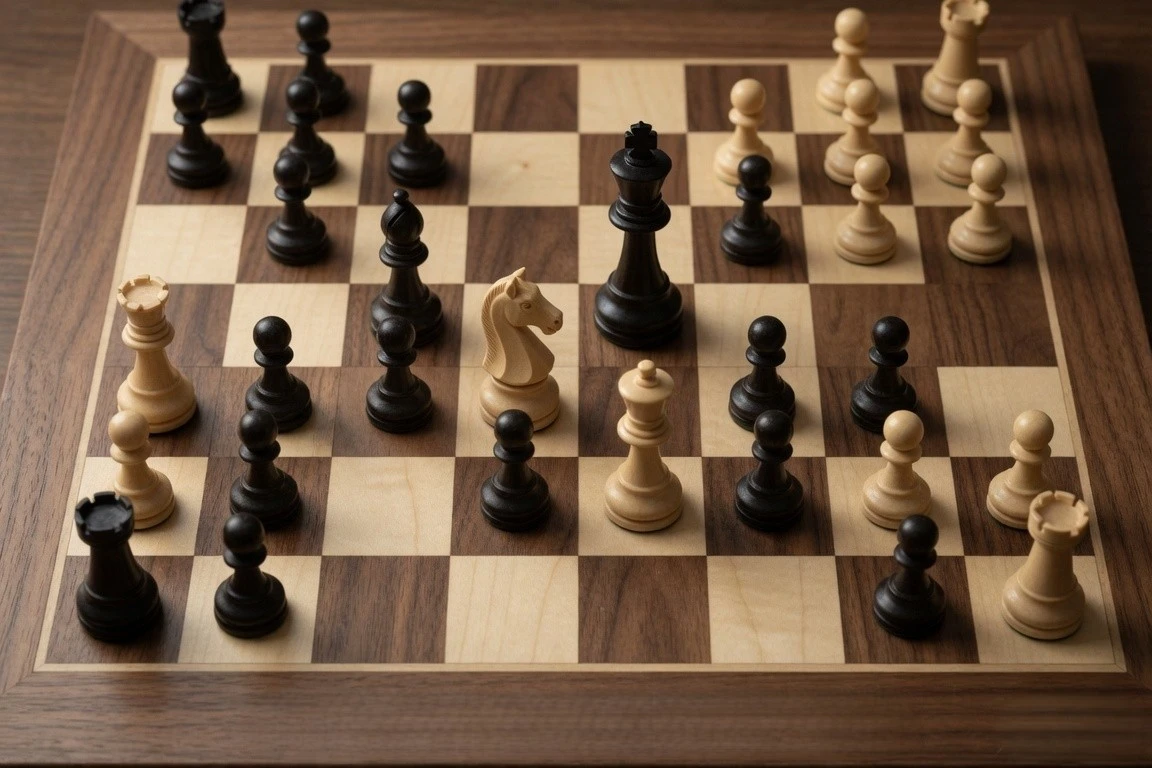
Before you can reliably prevent a threat, you must understand it with precision. Anastasia’s Mate occurs when a knight is posted on e7 (or its queenside mirror, c7), controlling the g6 escape square, while a rook or queen delivers checkmate on h8. The enemy king almost always castled kingside is hemmed in by its own unadvanced pawns on g7 and h7, which seal off every escape route. The result is a position where the king has zero legal moves and no piece can interpose.
What makes this pattern distinctly dangerous is the role of the defender’s own pawns as the prison walls. Most mating patterns rely on the attacker’s pieces to contain the king. Anastasia’s Mate inverts this it uses your defensive structure against you. The pawns that were supposed to keep your king safe become the bars of a cage. This inversion is precisely why so many players fail to see it coming until the moment the rook lands on h8 and the game is over.
The pattern can also arise with the queen replacing the rook, with the knight on f6 or g5 instead of e7 depending on the exact position, and on the a-file in the case of queenside castling. All variations share the same core DNA: a knight controlling a critical escape square, a linear piece delivering the final blow, and the king trapped by its own pawns. Keep this structure clearly in mind as we examine the seven mistakes that allow it to occur.
Mistake 1: Weakening the Kingside Pawn Structure
Of all the mistakes that enable Anastasia’s Mate, this is the most foundational and the most common. The pattern requires the g7- and h7-pawns to remain in place as prison walls. When players voluntarily weaken these pawns through unnecessary pawn advances, piece exchanges that expose the king, or structural concessions made without compensation they lay the groundwork for their own defeat.
The most frequent form of this error is the careless advance of the g-pawn to g6. Players often push g7–g6 to relieve pressure from an opposing bishop on the a2–g8 diagonal, to make room for a knight maneuver, or simply out of habit. But g6, while sometimes necessary, creates a permanent weakness on h6 and fundamentally alters the structure that makes Anastasia’s Mate possible. After g6, the knight on e7 no longer covers the critical escape square at that location but it may now threaten f8 or h8 through different lines. The pawn advance has not necessarily solved the problem; it has simply changed its geometry.
Similarly, advancing the h-pawn to h6 without a clear strategic reason is a double-edged decision. While h6 does give the king a flight square to h7, it also creates a hook a target on which the opponent can lever open the h-file even more aggressively with a well-timed g4–g5–gxh6. Every pawn advance in front of your castled king carries strategic consequences that must be weighed carefully. The guiding principle is this: do not move the pawns in front of your castled king unless you have a specific, calculated reason to do so.
Mistake 2: Ignoring Knight Maneuvers Toward e7 or f6
If Mistake 1 is the structural error that creates the conditions for Anastasia’s Mate, Mistake 2 is the attentional error that allows the attacker to complete their construction unopposed. Players who ignore an opponent’s knight maneuvering toward e7, f6, or g5 dismissing it as a routine repositioning rather than recognizing it as the keystone of a mating attack consistently find themselves on the wrong end of this pattern.
The knight’s journey to e7 is rarely sudden. It typically travels through natural-looking intermediate squares c6, d5, f5, or g6 all of which appear in the normal course of active piece play. This gradual, incremental approach is exactly what makes it so easy to overlook. Each individual knight move seems unremarkable in isolation; it is only when you step back and trace the trajectory that the destination becomes clear.
The correct response when you see your opponent’s knight approaching e7 is immediate evaluation: is this a genuine threat? Is the h-file open or about to be opened? Do I have a piece covering h8? If the answers form a pattern of danger, you must act at once either by trading off the knight before it reaches its destination, by advancing h7–h6 to give your king a flight square, or by launching counter-play that forces your opponent to abandon the mating plan in favor of defense. What you must never do is assume the knight is simply heading to a good square for positional reasons and ignore it entirely.
The knight’s journey to e7 is rarely sudden. It typically travels through natural-looking intermediate squares c6, d5, f5, or g6 all of which appear in the normal course of active piece play. This gradual, incremental approach is exactly what makes it so easy to overlook. Each individual knight move seems unremarkable in isolation; it is only when you step back and trace the trajectory that the destination becomes clear.
The correct response when you see your opponent’s knight approaching e7 is immediate evaluation: is this a genuine threat? Is the h-file open or about to be opened? Do I have a piece covering h8? If the answers form a pattern of danger, you must act at once either by trading off the knight before it reaches its destination, by advancing h7–h6 to give your king a flight square, or by launching counter-play that forces your opponent to abandon the mating plan in favor of defense. What you must never do is assume the knight is simply heading to a good square for positional reasons and ignore it entirely.
Mistake 3: Neglecting the Open or Semi-Open h-File
The h-file is the highway that Anastasia’s Mate travels. Without it, the rook cannot reach h8, and the pattern cannot be executed. This means that the moment the h-file becomes open or semi-open, it must register on your radar as a potential danger zone and the presence of your opponent’s rook or queen anywhere near that file should trigger immediate defensive evaluation.
The most common way the h-file is opened against the defender is through a pawn exchange initiated by the attacker. When your opponent advances their h-pawn to h5 and you exchange it with hxg6 or gxh5, you have opened the file yourself. Players make this exchange automatically, focused on the immediate pawn structure, without registering that they have just created the arterial route for a rook attack.
The solution is to develop what experienced players call h-file awareness a habit of consciously noting the status of the h-file at every stage of the game. Is it closed? Semi-open? Who benefits if it opens? If the answer is your opponent, consider whether you can prevent the opening, contest the file with your own rook, or at minimum ensure your king has an escape route before the file opens. Placing your own rook on h8 to contest the file, advancing a pawn to h6, or keeping pieces actively covering the back rank are all legitimate defensive measures that address the h-file threat directly.
Mistake 4: Overextending or Poor Piece Coordination
Chess attacking patterns do not succeed in a vacuum they succeed when the defender’s pieces are poorly placed, overextended, or simply not doing their jobs. Anastasia’s Mate is no exception. One of the most consistent features of positions where this pattern arises is that the defending player’s pieces are scattered, uncoordinated, or committed to tasks on the opposite side of the board from where the mating attack is developing.
Poor piece coordination in this context most often manifests as a misplaced bishop, a rook that is pinned or committed to a passive defensive task on a different file, or a queen that has ventured too far afield in search of queenside counterplay. Each of these individual positioning errors is minor in isolation. Combined, they create a situation where the attacker can build the entire mating net without encountering any meaningful resistance.
The corrective principle is active, coordinated defense. Every piece in your position should have a clear defensive role that covers the critical squares around your king particularly g6, h7, and h8. If you notice that none of your pieces are covering these squares, that is a warning sign that deserves immediate attention regardless of what else is happening on the board. Actively asking the question “what covers h8?” at regular intervals during the middlegame is a simple habit that prevents a remarkable number of back-rank disasters.
Free Demo Class for Kids
Mistake 5: Missing Tactical Warnings in the Middlegame
There is a reason experienced players describe tactics as a language patterns, like words, must be recognized before they can be understood. Players who have not deeply studied Anastasia’s Mate simply do not have the vocabulary to read the position correctly when the pattern begins to emerge. They see individual pieces and individual moves; they do not see the combination taking shape across multiple moves simultaneously.
Tactical warnings in the middlegame that signal Anastasia’s Mate is approaching include an opponent who has a knight on d5 or c6 that can reach e7 in one move, a rook that has shifted to the h-file without an obvious immediate purpose, a queen that is hovering near h4 or h5 with the h-file semi-open, and any sacrifice material or positional made specifically to remove the defender of h8 or to open the h-file. Any one of these signals alone might be innocuous. Two or more appearing simultaneously is a serious alarm.
The skill being described here is board vision the ability to read what the position is threatening to become, not just what it currently is. This skill is developed through consistent tactical training, and specifically through studying exactly the kinds of patterns this blog describes. The more positions you have seen where Anastasia’s Mate was the theme, the faster your pattern recognition will flag these warning signs in your own games before it is too late.
Mistake 6: Passive Defense Once the Pattern Emerges
This is the mistake that ends games even when the defender has correctly identified the threat. Having spotted that Anastasia’s Mate is being constructed, many players respond with passive, reactive defense moving pieces to cover the immediate threat without disrupting the attacker’s plan at its source. The result is a slow, grinding defensive retreat that the attacker systematically dismantles move by move until the mate is delivered.
Passive defense against Anastasia’s Mate typically looks like this: the defender places a rook on h8 to contest the back rank, the attacker trades rooks and resets; the defender moves the knight to f8 to cover g6, the attacker maneuvers to eliminate it; the defender advances h6 under pressure, the attacker uses it as a lever to crack the position open further. Each passive response is met by a precise active continuation, and the defender’s position deteriorates incrementally until it collapses.
The correct response to an emerging Anastasia’s Mate threat is active counter-play. Attack your opponent’s king. Generate threats on the other side of the board that demand the attacker’s attention. Offer material to deflect the knight from its outpost or force the opponent’s rook off the h-file. Look for a tactical shot that transforms the nature of the position entirely. Passive defense in chess, particularly against a well-coordinated mating attack, is almost always a losing strategy. The goal is not to slow down the inevitable it is to change the terms of the game entirely.
Mistake 7: Underestimating Queen Sacrifices or Decoys
Of all seven mistakes, this one produces the most sudden and shocking defeats. Players learn to track the knight’s journey toward e7 and monitor the h-file but they fail to account for the queen sacrifice or decoy that accelerates the combination by a critical move or two.
A queen sacrifice in the context of Anastasia’s Mate typically serves one of two purposes. The first is deflection the queen is sacrificed to eliminate the one piece that was preventing the rook from reaching h8 or the knight from reaching e7. The second is a tempo gain the queen delivers a check that forces the king into the exact position where the mating net closes. In both cases, the queen sacrifice is not an act of desperation; it is the most powerful move on the board in that specific moment.
Players who have not seen or studied queen sacrifices that lead to Anastasia’s Mate instinctively dismiss them as mistakes or bluffs surely the opponent has simply miscalculated and left their most powerful piece hanging? This instinct, however natural, is catastrophically wrong in these positions. When your opponent sacrifices their queen near your kingside and the h-file is open and a knight is hovering near e7, you must calculate the resulting position with absolute precision before accepting the sacrifice. The material you gain may be irrelevant if checkmate follows on the very next move.
General Prevention Strategies and Pro Tips
Beyond the seven specific mistakes above, a set of broader defensive principles will make your king consistently harder to attack and your position reliably resistant to the Anastasia’s Mate pattern.
Develop h-file consciousness as a permanent habit. At every move of the middlegame, note the status of the h-file closed, semi-open, or open and ask whether your opponent benefits from its further opening. This single habit catches a remarkable number of mating threats before they become unstoppable.
Always know who covers h8. In any position where your king is castled kingside, maintain a clear mental picture of which piece your rook, your queen, your bishop has h8 covered. The moment that coverage disappears without replacement, treat it as an emergency.
Trade off the attacking knight early. When you identify your opponent’s knight heading toward e7, the single most reliable defensive measure is to eliminate it before it arrives either by exchanging your own knight or bishop for it, or by advancing a pawn to control the square it needs to pass through. A knight that never reaches e7 cannot participate in Anastasia’s Mate.
Maintain escape squares proactively. Rather than advancing h7–h6 in desperation once the attack has already arrived, make this move earlier in the middlegame when it costs you nothing. A timely h6 prevents a whole category of back-rank mating attacks, not just Anastasia’s Mate, and is almost never a serious concession if played before the attacker’s pieces are active.
Study the pattern from both sides. The best defensive players are also strong attacking players. By practicing the construction of Anastasia’s Mate from the attacker’s perspective drilling the five steps, solving the puzzles, playing it out in training games you build the pattern recognition that makes you a far more reliable defender. You cannot consistently prevent a threat you do not fully understand.
General Prevention Strategies and Pro Tips
Beyond the seven specific mistakes above, a set of broader defensive principles will make your king consistently harder to attack and your position reliably resistant to the Anastasia’s Mate pattern.
Develop h-file consciousness as a permanent habit. At every move of the middlegame, note the status of the h-file closed, semi-open, or open and ask whether your opponent benefits from its further opening. This single habit catches a remarkable number of mating threats before they become unstoppable.
Always know who covers h8. In any position where your king is castled kingside, maintain a clear mental picture of which piece your rook, your queen, your bishop has h8 covered. The moment that coverage disappears without replacement, treat it as an emergency.
Trade off the attacking knight early. When you identify your opponent’s knight heading toward e7, the single most reliable defensive measure is to eliminate it before it arrives either by exchanging your own knight or bishop for it, or by advancing a pawn to control the square it needs to pass through. A knight that never reaches e7 cannot participate in Anastasia’s Mate.
Maintain escape squares proactively. Rather than advancing h7–h6 in desperation once the attack has already arrived, make this move earlier in the middlegame when it costs you nothing. A timely h6 prevents a whole category of back-rank mating attacks, not just Anastasia’s Mate, and is almost never a serious concession if played before the attacker’s pieces are active.
Study the pattern from both sides. The best defensive players are also strong attacking players. By practicing the construction of Anastasia’s Mate from the attacker’s perspective drilling the five steps, solving the puzzles, playing it out in training games you build the pattern recognition that makes you a far more reliable defender. You cannot consistently prevent a threat you do not fully understand.
Free Demo Class for Kids
Conclusion: Stay One Step Ahead
Every chess player, at some point in their development, loses to Anastasia’s Mate. It is a rite of passage a painful and memorable lesson in the dangers of a weakened kingside, an unmonitored h-file, and an underestimated knight. But it need only happen once. The seven mistakes catalogued in this blog weakening the kingside pawn structure, ignoring knight maneuvers toward e7, neglecting the h-file, poor piece coordination, missing tactical warnings, passive defense, and underestimating queen sacrifices are all entirely preventable with the right knowledge and habits.
The goal is not to become paranoid about every knight move your opponent makes or to freeze every time the h-file opens. The goal is to develop the tactical fluency that allows you to read the warning signs early, respond actively and precisely, and remain consistently one step ahead of the pattern that has ended so many games so abruptly.
At Venture Chess Academy, we teach tactical awareness as an ongoing discipline not a checklist to complete, but a lens through which every position is evaluated. Anastasia’s Mate is one of the clearest tests of that awareness. Pass it consistently, and you will find that your game across the board your structural instincts, your tactical alertness, your defensive composure has grown significantly in the process.
The board is always teaching. The question is whether you are listening.
FAQ
Anastasia’s Mate in its classic form targets a kingside-castled king, but the same pattern applies on the queenside with the king on a8 or b8, pawns on a7 and b7, and the knight on c7 covering the a6 escape square while the rook delivers mate on a8. Any time a king is trapped on the edge of the board by its own pawns with an open file leading to it, the Anastasia’s Mate geometry is potentially in play. The defensive principles outlined in this blog apply equally to both sides of the board.
If forced to name one defensive move, it is h7–h6, played early and proactively. This pawn advance gives the king a flight square on h7, which destroys the closed pawn structure that the mating pattern depends on. While h6 does create a minor pawn weakness that a very strong opponent might exploit in a different way, it neutralizes the specific geometry of Anastasia’s Mate reliably and is generally a sound prophylactic measure in positions where the kingside is under pressure.
Yes but recovery requires immediate, active counter-play rather than continued passive defense. If your kingside pawn structure is weakened, the h-file is open, and your opponent’s knight is approaching e7, your best practical chance is almost always to create urgent threats on the other side of the board that force your opponent to abandon or delay the mating plan. Counter-attacking your opponent’s king, launching a queenside pawn storm, or finding a tactical shot that disrupts the attacking knight’s route to e7 are all legitimate recovery strategies.
The most effective method is pattern-specific puzzle training. Solve 10 to 15 Anastasia’s Mate puzzles daily for four to six weeks, including both attacking and defensive versions. Over time, the visual patterns associated with the setup the knight’s route to e7, the open h-file, the unguarded back rank become automatic triggers that your brain flags without conscious effort. Post-game analysis is equally important: review every game specifically looking for moments when the Anastasia’s Mate conditions were present, whether or not the pattern was executed.
Yes. Openings that develop the kingside bishop actively before castling, maintain flexibility in the h-pawn, and avoid early pawn advances in front of the castled king generally create less hospitable conditions for this mating pattern. Systems like the King’s Indian setup for Black (with pawns on g6 and d6 rather than g7 and h7 unmoved) alter the pawn structure enough to prevent the classic form of the mate, though they introduce other structural considerations. The broader principle is that active, coordinated piece development with a clear plan for the king’s safety is the most reliable long-term prevention against all mating attacks, including Anastasia’s Mate.