Reaching an endgame with an extra pawn is one of the most common winning scenarios in chess. However, many developing players make the frustrating mistake of allowing a lone defending King to hold a draw or force a stalemate.
Converting a single pawn advantage into a checkmate isn’t about luck it relies on concrete mathematical rules and positional patterns.
At Venture Chess Academy, we teach our students three golden endgame rules to master the King and Pawn vs King endgame: the Rule of the Square, Opposition, and Key Squares. Here is your step-by-step guide to winning every time.
1. The Rule of the Square
Before bringing your King over to support your pawn, you first need to calculate whether your pawn can run down the board and promote on its own. You can determine this instantly using The Rule of the Square without calculating move-by-move.
How to Calculate the Square
Count the number of squares your pawn needs to reach the promotion square (including the square it is currently standing on).
Count that same number of squares sideways toward the enemy King to form an imaginary square on the board.
The Rule: If the enemy King can step inside that imaginary square on their turn, the King will catch your pawn. If the King cannot step inside the square, your pawn will promote freely without any help from your King!
2. The Power of Opposition
If the enemy King is inside the square, your pawn cannot advance alone. You must bring your King forward to clear the path. To do this, you must master Opposition.
What is Opposition?
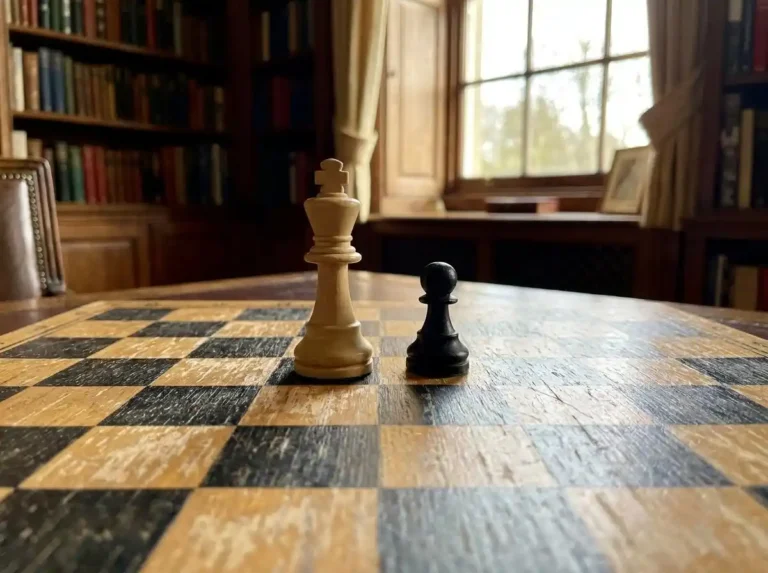
Opposition occurs when two Kings face each other on the same rank, file, or diagonal with only one empty square between them.
The player whose turn it is to move is at a disadvantage because they must move their King away, stepping aside and allowing the opposing King to advance.
Direct Opposition: When the Kings face each other on the same file with one square between them.
The Key Rule: Always place your King in front of your pawn to claim opposition. Once the enemy King steps aside to the left or right, advance your King forward diagonally (this is called outflanking) to shield your pawn’s path to promotion.
3. Controlling Key Squares
Winning a King and Pawn endgame requires understanding Key Squares. Key squares are critical squares in front of your pawn. If your King reaches any of these squares, you are guaranteed to promote your pawn regardless of whose move it is!
Rules for Key Squares
Pawn on the 2nd, 3rd, or 4th Rank: The key squares are the three squares two ranks in front of your pawn. If your King occupies any of those three squares, promotion is guaranteed.
Pawn on the 5th or 6th Rank: The key squares expand to the three squares directly in front of your pawn.
The Golden Rule: Always lead with your King first! Pushing your pawn ahead of your King allows the opponent to take opposition and block your path.
Avoiding Endgame Stalemate Traps
Even when you know the rules, two common pitfalls can ruin a winning position:
Rook Pawns (a-pawn or h-pawn): If your extra pawn is on the edge of the board (a-file or h-file), the enemy King can sit in the corner square. Because there is no room to outflank the defender on the edge, the game is an automatic draw if the defender reaches the corner first.
Trapping the King: Never push your pawn to the 7th rank unless it delivers check or promotes. Pushing a pawn to the 7th rank without checking the enemy King often results in an immediate stalemate.
Free Demo Class for Kids
Master Chess Endgames at Venture Chess Academy
Endgame calculations require patience, pattern recognition, and precise execution. Practice makes perfect, and receiving guided feedback on your endgame technique is the fastest way to rating improvement.
At Venture Chess Academy, whether you prefer structured offline training or interactive online chess classes, our expert curriculum is designed to help students master critical tactical concepts with ease.
Our students regularly put these principles into action, achieving top results in FIDE-rated tournaments and international events. With small batch sizes (capped at 5 students), every student receives individual coaching tailored to their skill level.
Book a 60-minute free interactive session with our FIDE-rated coaches to discover how Venture Chess Academy can transform your child’s focus and cognitive skills.
FAQ
Q:What is the Rule of the Square in chess?
The Rule of the Square is a visual technique used to determine if a defending King can catch a passed pawn. Count the number of squares from the pawn to its promotion square, then construct an imaginary square of that size. If the enemy King can step inside the square on their turn, they can stop the pawn.
Q: How do you win with King and Pawn vs King?
To win, bring your King out in front of your pawn to secure “Opposition” and control key squares. Use your King to block the enemy King, creating a clear pathway for your pawn to march down the board and promote safely.