Mastering how the knight moves is very important for any chess player. Unlike other pieces, the knight moves in an “L” shape: it moves two squares in one direction and then one square in another, or the other way around, one square and then two. The knight can jump over any pieces on the board, which is something no other piece can do. It captures by landing on a square that has an opponent’s piece. Every time the knight moves, it goes from a light-colored square to a dark one or the other way around. Here are the steps to really understand how it works.
How the Knight Moves in Chess (Rules, Jumping & Tactics)
Among all the pieces on a chessboard, the Knight stands out as the most unique, tricky, and dangerous piece for beginners to face.
Unlike the Rook, Bishop, or Queen which all move in straight, continuous lines the Knight moves in a very specific “L” shape. Even more importantly, the Knight is the only piece on the board that has the magical ability to jump directly over other pieces.
Because of its unusual movement, the Knight is a master of surprise attacks. In this guide by Venture Chess Academy, we will break down exactly how the Knight moves, where it belongs on the board, and how you can use it to launch devastating tactical strikes.
1. The "L-Shape" Rule: How the Knight Moves
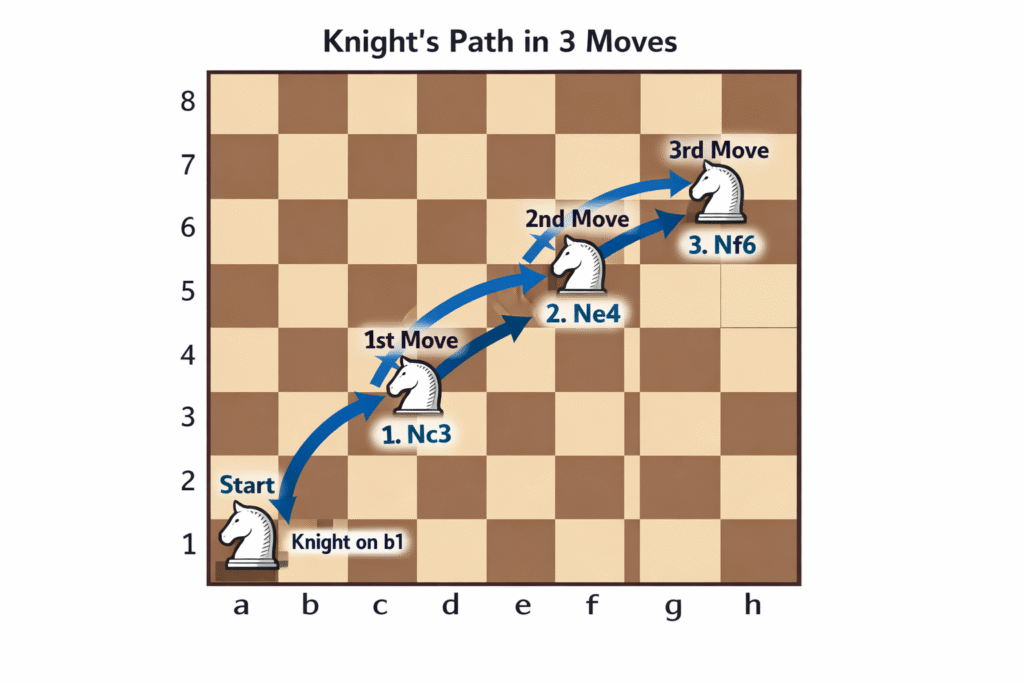
A Knight is worth 3 points in a standard chess evaluation. To move it, you must follow the strict “L-Shape” pattern.
The Knight moves exactly three squares per turn:
- Two squares horizontally, then one square vertically.
- OR two squares vertically, then one square horizontally.
The Color-Change Rule: There is a fantastic trick to make sure you are moving your Knight correctly. Every single time a Knight moves, it must land on the opposite color square. If your Knight starts its turn on a light square, its L-shape jump will always land on a dark square. If it lands on the same color, you have made an illegal move!
2. Jumping and Capturing
The Knight’s superpower is its ability to jump over obstacles. Whether it is a wall of your own pawns or an enemy barricade, the Knight simply leaps over them.
However, beginners often get confused about how Knights capture.
- The Knight does NOT capture pieces it jumps over.
- The Knight ONLY captures the piece on its final landing square.
If an opponent’s piece is sitting on the exact square where your Knight finishes its “L” shape, you remove their piece from the board and place your Knight there.
3. Placement Matters: "A Knight on the Rim is Dim"
Because the Knight is a short-range jumping piece, its placement on the board drastically changes how powerful it is.
- In the Center: A Knight placed squarely in the center of the board (like on the d4 or e4 squares) is a monster. It attacks 8 different squares simultaneously!
- On the Edge: A Knight placed on the edge of the board (like on the a4 or h4 files) only controls 4 squares.
- In the Corner: A Knight stuck in the very corner (like a1 or h8) only controls a miserable 2 squares.
This leads to one of the most famous chess sayings: “A Knight on the rim is dim.” Always try to develop your Knights toward the center of the board where they have maximum mobility!



4. The Ultimate Knight Tactic: The Fork
Because the Knight attacks in an awkward L-shape, it often approaches enemy pieces from blind spots. This makes the Knight the absolute best piece for executing a tactical Fork.
A fork happens when one of your pieces attacks two (or more!) enemy pieces at the exact same time. The most devastating fork in chess is the “Royal Fork,” where your Knight attacks the enemy King (Check) and the enemy Queen simultaneously. Since the opponent is forced to save their King, you get to capture their Queen on the very next turn!
Master the Board with Venture Chess Academy
Understanding how the Knight moves is just step one. Turning that knowledge into winning tactics requires structured practice and expert coaching.
At Venture Chess Academy, we provide highly structured online chess classes for kids aged 6 to 15. In fact, our curriculum is specifically broken down into skill-based batches, progressing from absolute beginners in the “Pawn” batch straight into our tactical “Knight” batch!
Led by FIDE rated personal chess instructors, our live interactive chess classes online feature customized game analysis and tactical puzzle quests designed to sharpen your child’s board vision.
Ready to help your child master the board and jump over the competition?
Free Demo Class for Kids
Let your child explore 60-minute free interactive session with FIDE Rated coaches.
Enroll HereConclusion
The knight is a distinctive and potent chess piece that rewards creativity, careful planning, and an understanding of positional play. From simple moves to advanced tactics like forks, from clever placement to essential endgame strategies, getting good at using the knight can significantly improve your chess skills.
By looking at famous knight moves, practicing common tactical patterns, and learning when to move your knight to the center or reposition it, you develop a better understanding of this amazing piece.
In chess, there’s nothing quite like the satisfaction of delivering a powerful knight fork or seeing your knight take control of the board.
If you want to get better at chess, start by mastering the knight’s moves it’s a skill that helps you at every level of play.
Frequently Asked Questions (FAQs)
It moves in an L-shape and attacks pieces in a way that’s not always obvious, making it harder to spot its threats compared to other pieces.
Yes. Knights are the only pieces in chess that can jump over both your own pieces and your opponent’s pieces.
It depends on the situation. Knights usually perform better in positions where the board is closed, while bishops are stronger in open positions.
A knight fork is a chess tactic in which a knight attacks two or more pieces simultaneously, often placing the opponent in a difficult position.
You can improve by practicing tactical exercises, studying games played by strong players, and learning how to place your knights in the center of the board and on strong squares.